
Apex Trader Funding Review & Discounts 2026

See the most recent Apex Trader Funding sales and promotions below
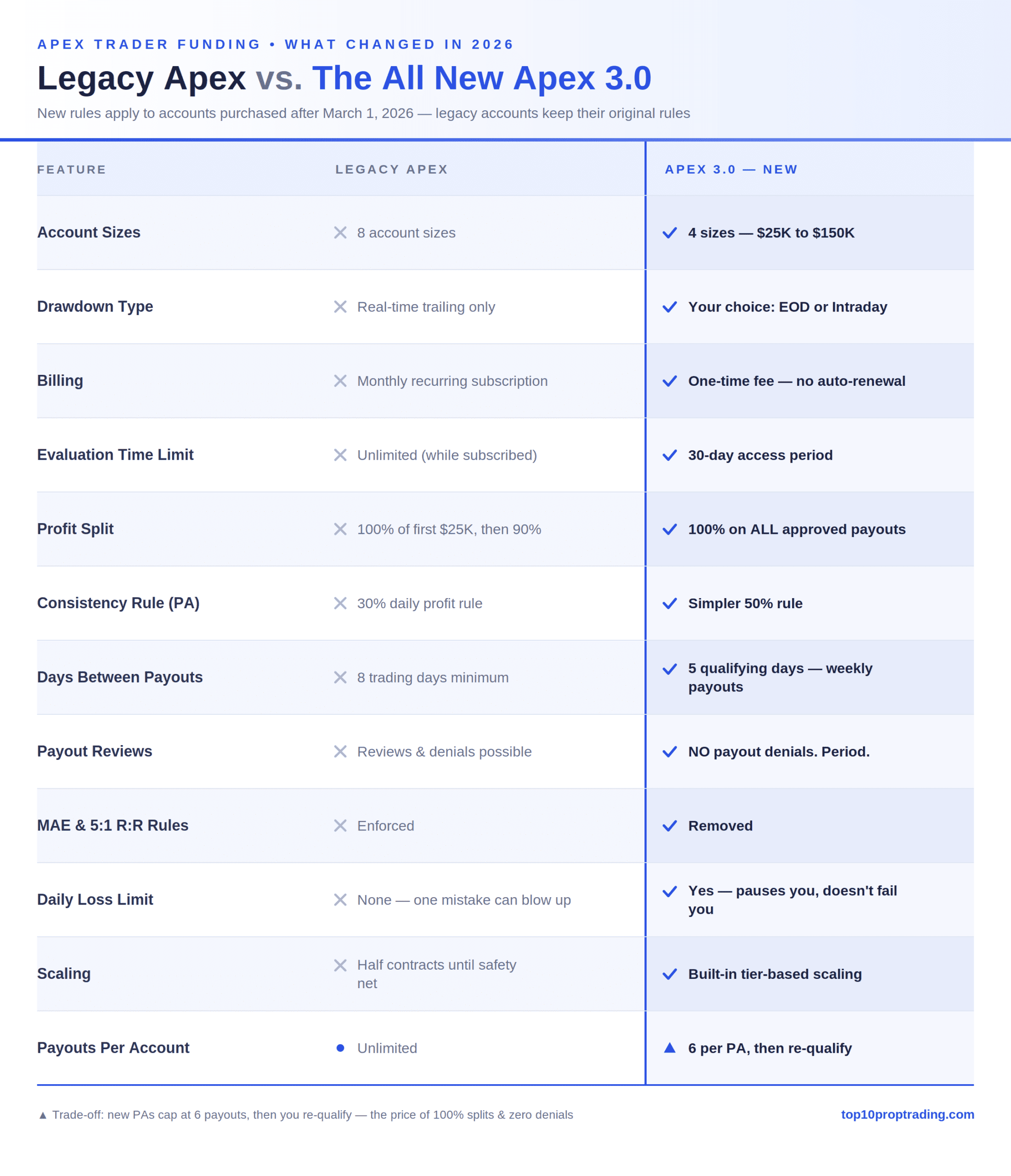
In March 2026, Apex launched its biggest overhaul yet: the “All New Apex,” often called Apex 3.0. This is not a minor rule tweak. It is a completely rebuilt program with a new account structure, a new end-of-day drawdown option, one-time pricing, and a dramatically simplified rulebook. Apex sums up the new philosophy in four words: Simplicity, Freedom, Fairness, Trust.
The headline changes traders have been asking for:
- EOD (End-of-Day) drawdown accounts: no more real-time trailing drawdown eating your open profit (on the end-of-day path).
- No payout denials: no payout reviews, no video reviews of your trading, no chart screenshots.
- No MAE rule: Apex has scrapped it entirely. How far a trade goes against you mid-trade is no longer judged or reviewed.
- No 5:1 risk/reward rule: Apex no longer dictates your risk-to-reward ratio at all. You can scalp 2-point wins with wide stops if that is your style.
- One-time fees: no more recurring monthly billing on new accounts.
- Built-in tier-based scaling: the new system that controls how many contracts you can trade in your Performance Account, replacing the old “half contracts until you clear the safety net” rule.
- A single, clear 50% consistency rule: replacing the old 30% rule. No more than 50% of your profits can come in a single trading day.
- 100% payout split: no profit split on Sim Funded accounts at all.
If you bought Apex accounts before March 1, 2026, those are now “Legacy” accounts. They keep their old rules, old billing, and old payout structure. Nothing changed retroactively, but they are no longer available for new purchase. You can hold a mix of legacy and new accounts at the same time.
This review covers the new program in detail.
Apex Trader Funding Account Types
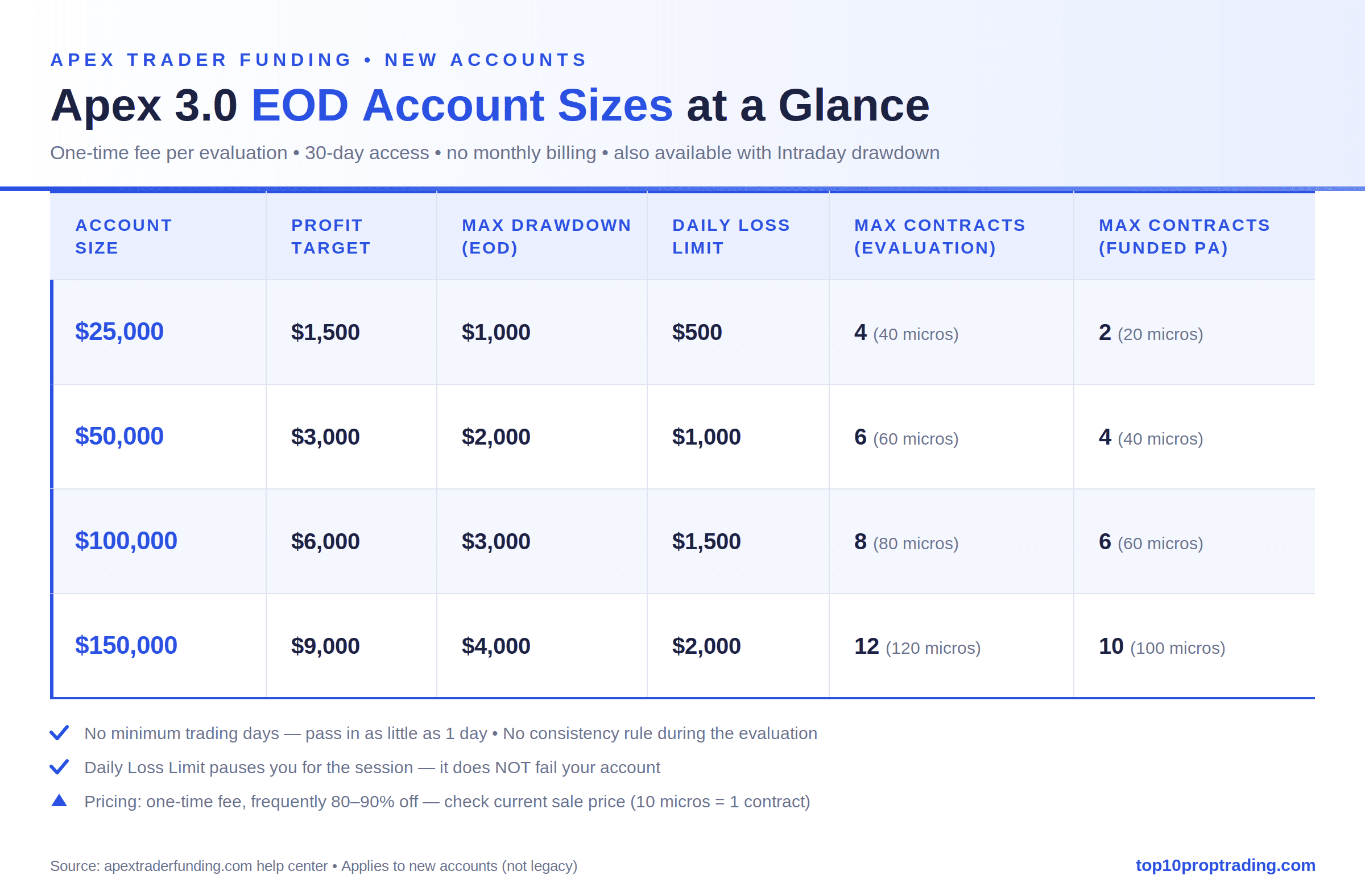
The new Apex gives you two decisions to make at checkout, and both matter.
Decision 1: Drawdown type
- EOD Trail drawdown is calculated once per day at market close. Your open intraday profit is NOT counted against you in real time. EOD accounts also include a Daily Loss Limit (DLL) that pauses your session if hit, it does not fail your account.
- Intraday Trail the traditional real-time trailing drawdown at a lower price point. Same profit targets, same max drawdown, same contract limits as EOD, but no Daily Loss Limit, so there’s no session circuit-breaker between you and the drawdown line.
Decision 2: Fee structure
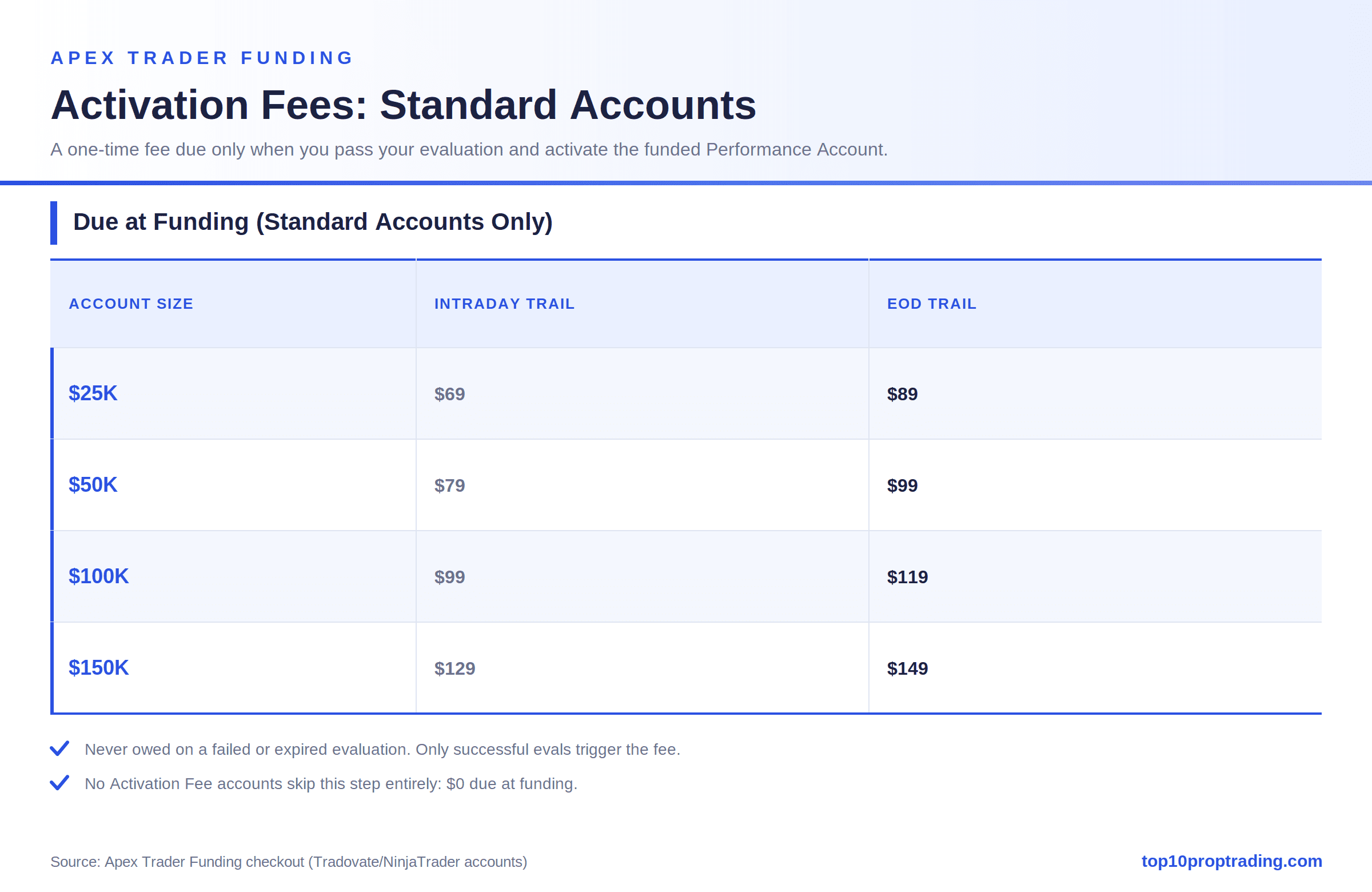
- Standard a lower evaluation fee now, plus a one-time activation fee ($69–$149 depending on size and type) when you pass and activate your funded account.
- No Activation Fee a higher single payment that covers everything. Pass your eval and you owe $0 at funding.
Which is cheaper? It depends on whether you pass. At typical coupon pricing, No Activation Fee works out cheaper per funded account, but if an evaluation fails, standard costs far less, because the activation fee is never owed on a busted eval. Confident, experienced traders lean No Activation Fee, traders expecting to burn a few evals lean Standard. (Full math below.)
Account sizes have been streamlined from eight options down to four: $25K, $50K, $100K, and $150K. You can still trade up to 20 accounts simultaneously (using a trade copier such as Replikanto), and the 20-account cap applies across all PAs combined.
How the Evaluation Works
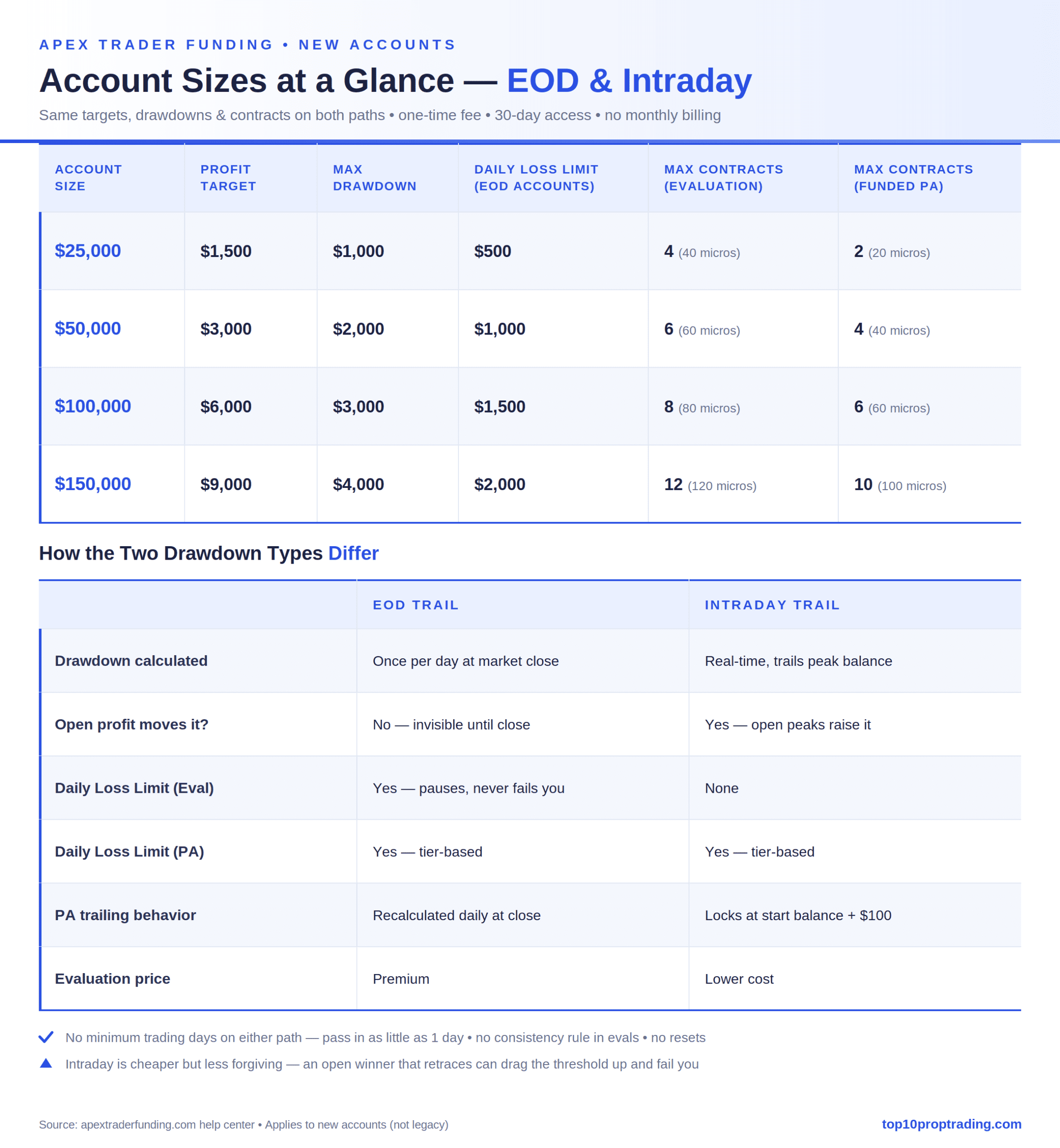
The account parameters in the graphic above are identical on both paths. What differs is how the drawdown behaves:
End of Day (EOD): the threshold is calculated once per day at market close and stays fixed for the entire next session. Open intraday profit never moves it.
Intraday Trailing: the threshold follows your highest achieved balance (Peak Balance) in real time, including unrealized gains, and it never moves down, not even at the end of a losing day. It does not reset daily; it trails your peak for the life of the evaluation. When the threshold is breached, liquidation happens at market price, so your final balance may land slightly above or below the line, but a touch is a touch, and the evaluation is failed either way.
In short: Intraday is cheaper but less forgiving. An open winner that retraces can drag your threshold up and fail you in ways the EOD model can’t. That is the trade-off you are making for the lower price.
The rules of the test itself:
- Reach the profit target without touching the drawdown threshold. That is the whole test.
- No minimum trading days. You can pass in a single day.
- No consistency rules during the evaluation.
- 30-day access period. Each evaluation gives you 30 calendar days to hit the target. This replaces the old open-ended monthly subscription.
- No resets. Under the legacy program you could pay $80–$100 to reset a failed evaluation. New accounts have no reset option at all. If you blow the drawdown or run out the 30-day clock, that evaluation is done and you buy a new one. The flip side: with evals as cheap as they are on coupon (under $20 for a 25K Intraday at 90% off), a fresh eval often costs less than the old reset fee did.
- Daily Loss Limit (EOD accounts): hitting your DLL pauses trading for the rest of the session. Your account stays alive and resets at the next session open. The trading day resets at 6:00 PM ET.
- No hedging evaluations against each other. Apex explicitly prohibits passing evaluations by offsetting positions across accounts.
Once you pass, you have 7 calendar days to activate your Performance Account.
Pricing: What Evaluations Actually Cost
Every new Apex account is a one-time fee with 30-day evaluation access. No monthly subscription, no auto-renewal, no recurring billing to remember to cancel, and no refunds.
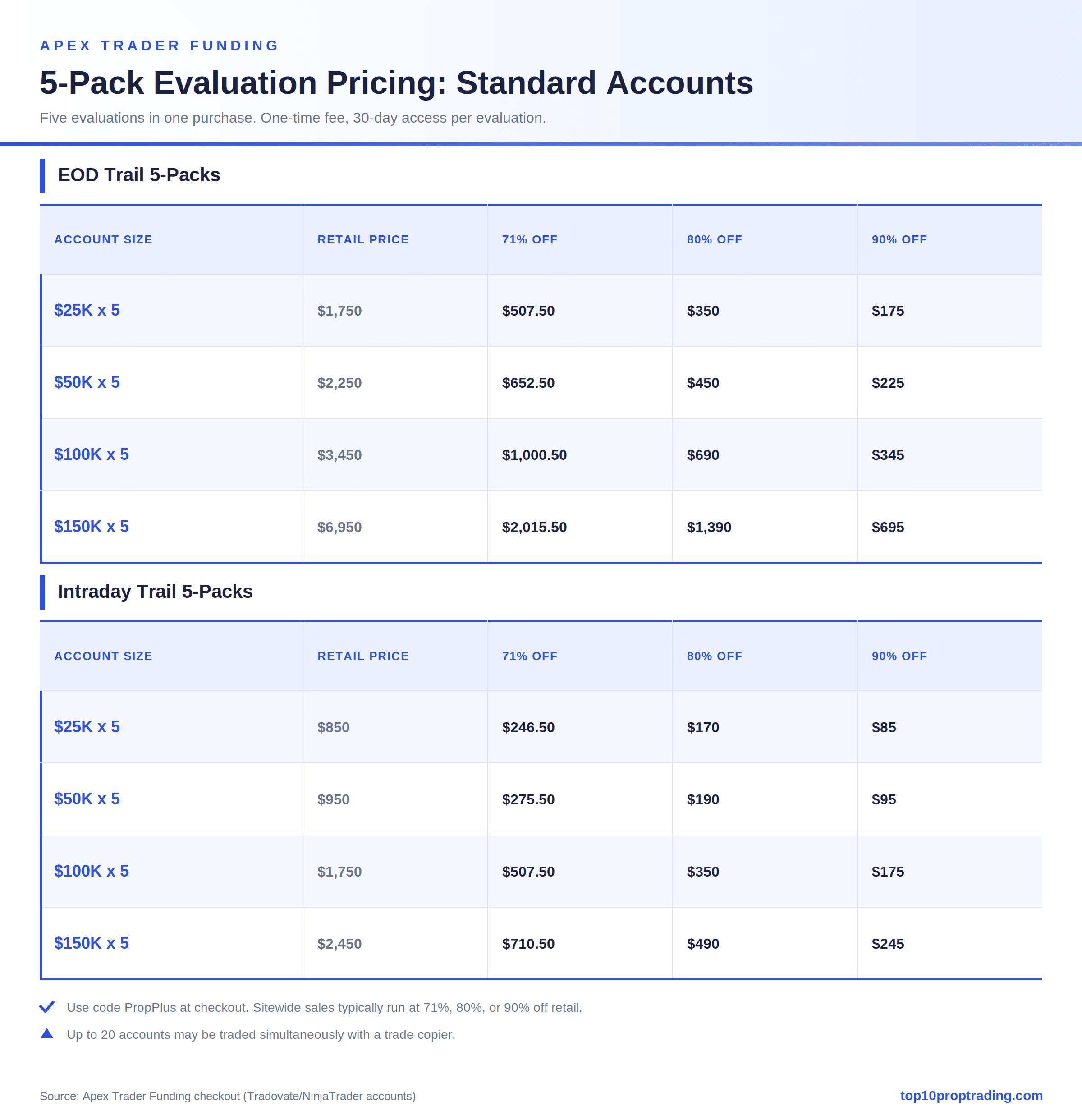
Apex runs sitewide sales almost constantly, and the discount level typically lands at one of three tiers: 71%, 80%, or 90% off retail. Use code PropPlus at checkout to apply the current sale. The tables below show retail pricing alongside all three discount tiers so you can see exactly what you’ll pay at whichever level is running. Prices are subject to change; verify at checkout.
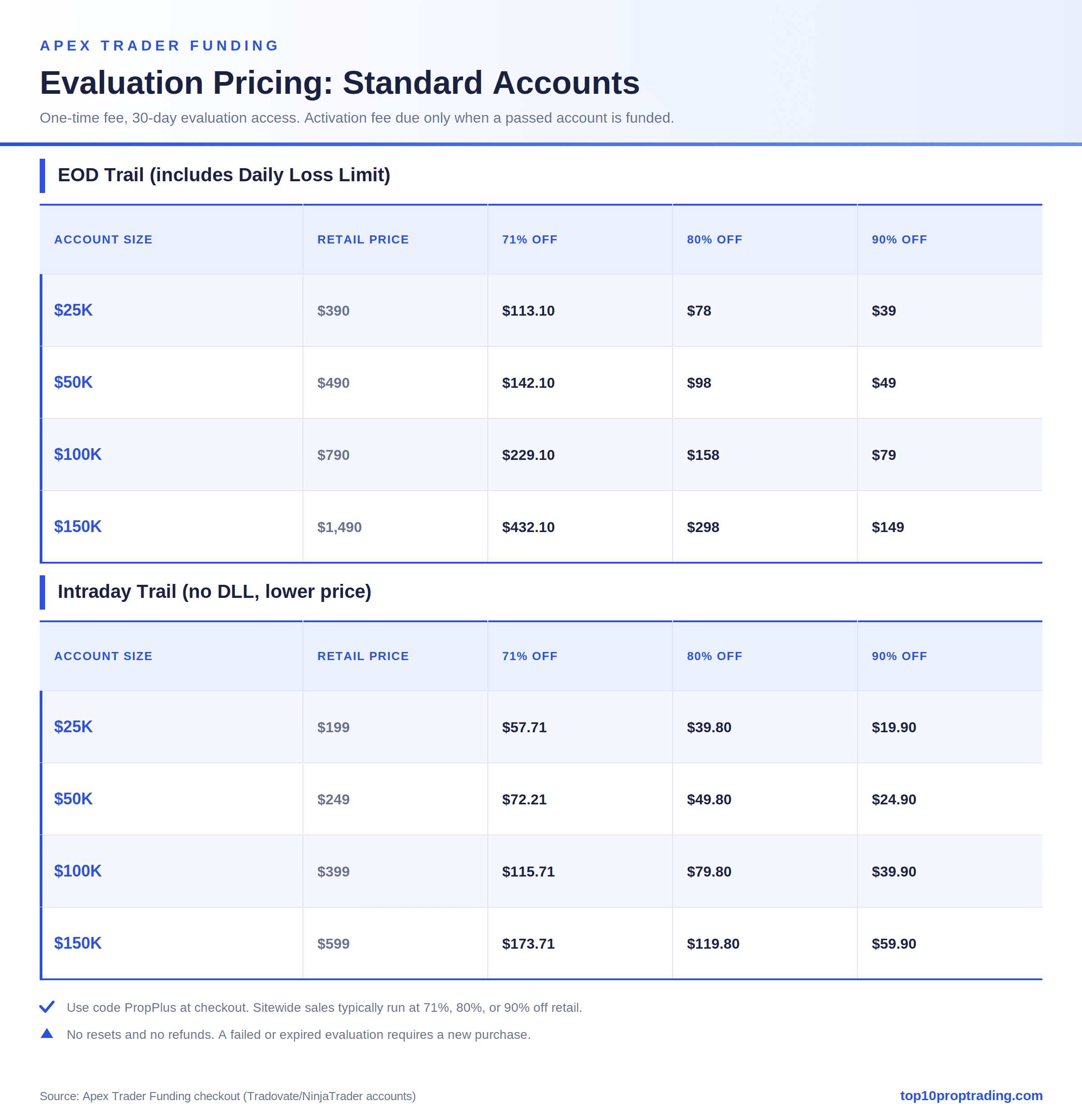
Standard accounts pay the one-time activation fee at funding. No Activation Fee accounts cost more upfront but owe nothing when you pass:
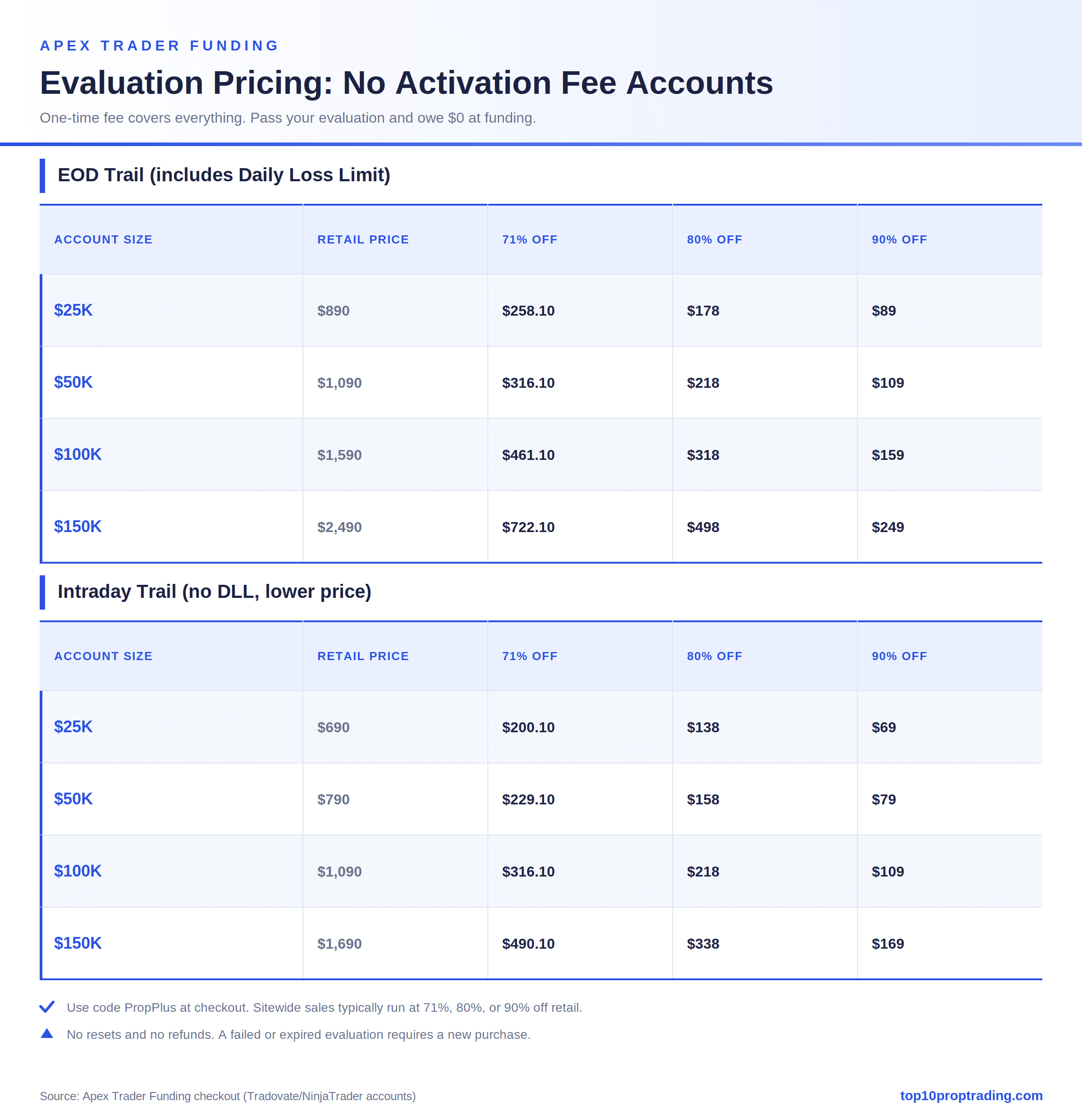
Note that the premium for the EOD model grows with account size: about $200 over Intraday at $25K, but $500 at $100K and $800 at $150K. At the larger sizes, the end-of-day drawdown convenience costs meaningfully more.
Activation Fees (Standard Accounts)
Legacy accounts (pre-March 1, 2026): remain on their original recurring monthly billing until canceled, keep their old rules (including paid resets), and continue progressing into legacy PAs. Legacy products are no longer for sale.
Apex Trader Funding Trading Performance Accounts (PA)
The Performance Account is a Simulated Funded (Sim Funded) account, issued in the same size and drawdown structure as the evaluation you passed.
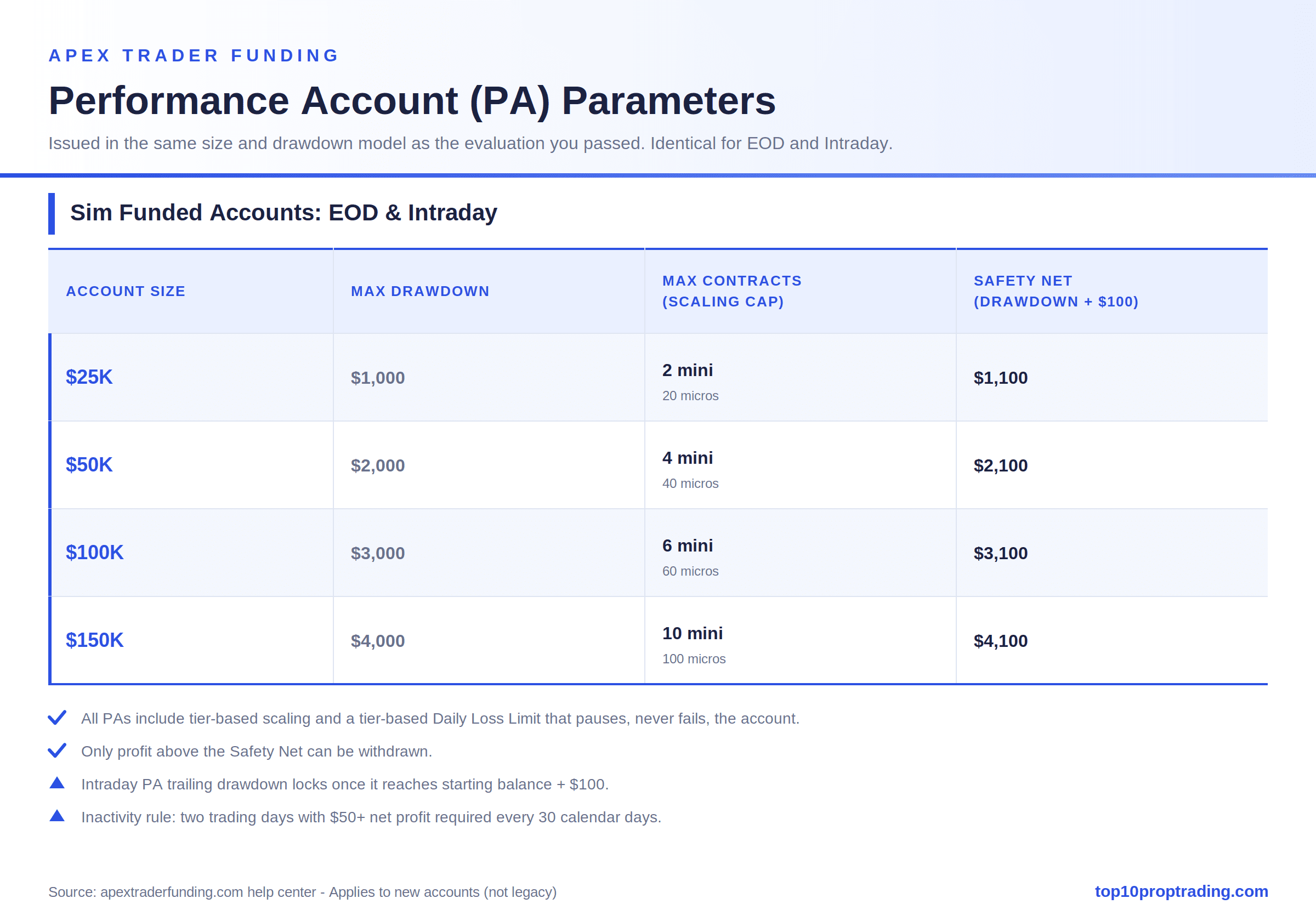
These parameters are identical for EOD and Intraday PAs; the difference remains how the drawdown is calculated. Two Intraday-specific details worth highlighting:
- The Intraday PA trailing drawdown stops moving once it reaches your starting balance + $100. Once you have earned your drawdown amount in profit, the threshold locks, just like the legacy “safety net” behavior. From that point forward, the real-time trailing disadvantage disappears.
- The Intraday PA includes a Daily Loss Limit even though the Intraday evaluation does not. Once funded, both account types have the tier-based DLL circuit-breaker.
Note that PA contract limits are lower than evaluation limits. A 100K eval allows 8 contracts, but its PA caps at 6 through scaling. Don’t expect to carry your evaluation size into the funded account on day one.
Inactivity rule: your PA must record at least two trading days with $50+ net profit within every 30 consecutive calendar days, or the account is closed. Part-time traders should put this on the calendar.
PA Trading Rules - Dramatically Simplified
The old PA rulebook (30% daily profit cap, 30% max unrealized, 5:1 risk/reward, MAE limits, flipping limits, half-contracts-until-safety-net, defined-strategy requirements) is gone on new accounts. The new rules:
- Don’t breach the EOD drawdown. Your balance, including unrealized P&L, may never touch the threshold. If it does, positions are liquidated and that PA is permanently closed.
- Respect the Daily Loss Limit. Hitting the DLL does not close your PA; it pauses trading for the rest of the session.
- No prohibited activity (hedging violations, rule circumvention, and similar).
Tier Based Scaling (Performance Accounts)
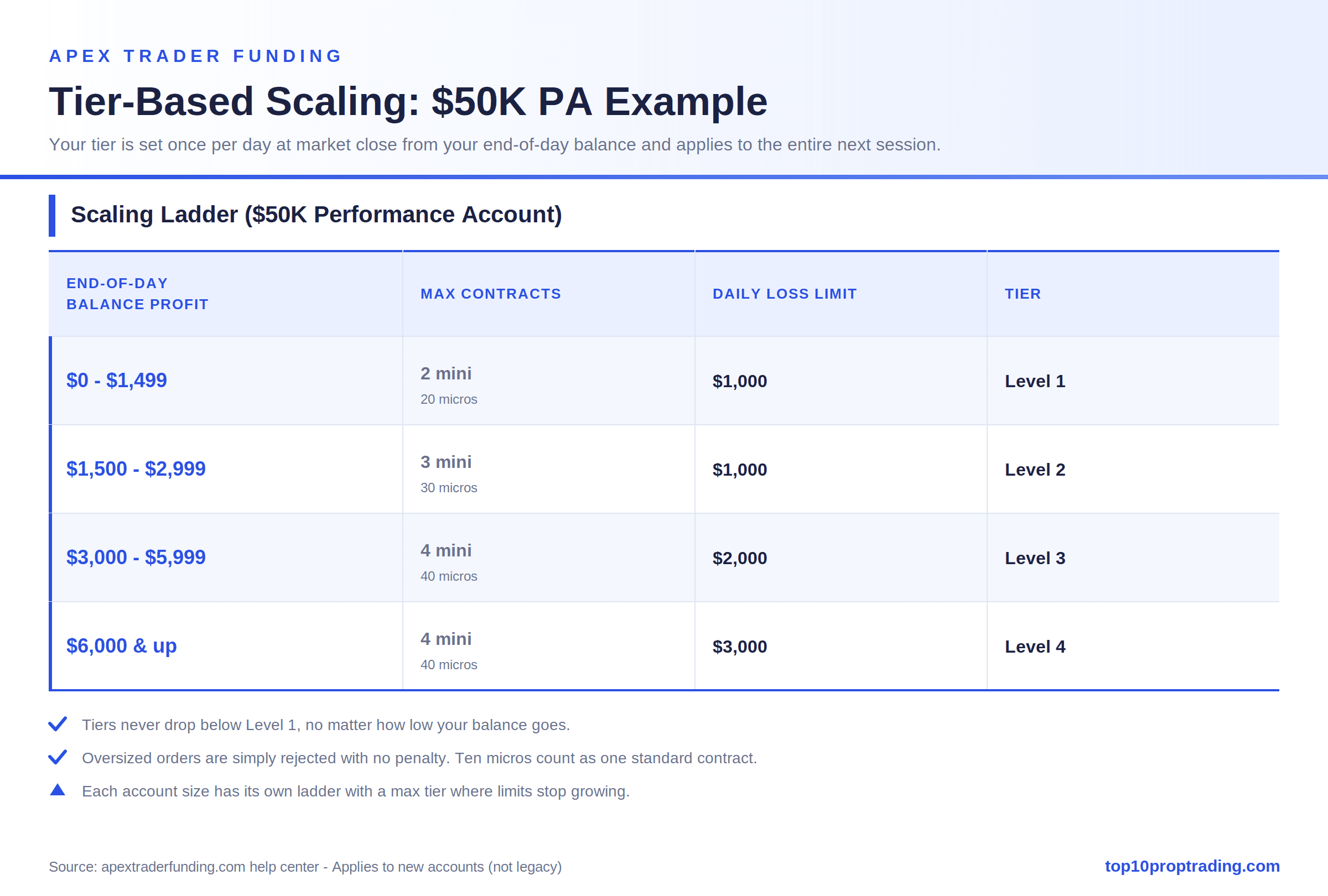
Position size in a PA is not fixed. It follows scaling tiers based on your end-of-day balance. Your tier is set once per day at market close and applies to the entire next session. Tier up and you get more contracts and a bigger DLL. Tier down and both shrink, but never below Level 1, no matter how low your balance goes. Each size has a max tier where limits stop growing.
Enforcement is automatic and forgiving: an order that would exceed your tier’s max size is simply rejected, with no penalty. Ten micros count as one standard contract, and the limit applies to total exposure across all instruments combined.
Example: $50K PA ladder:
Apex Trader Funding Payout Process
This is where Apex 3.0 is rebuilt most aggressively.
Payout split: 100%. Not “100% of the first $25,000, then 90%.” You keep all of every approved payout.
No payout denials. No payout reviews, no video reviews of your trading, no chart screenshots, no “interpretation” of rules. Everyone is under the same rule set. The only automatic denial: if your balance falls below the required threshold after you submit a request.
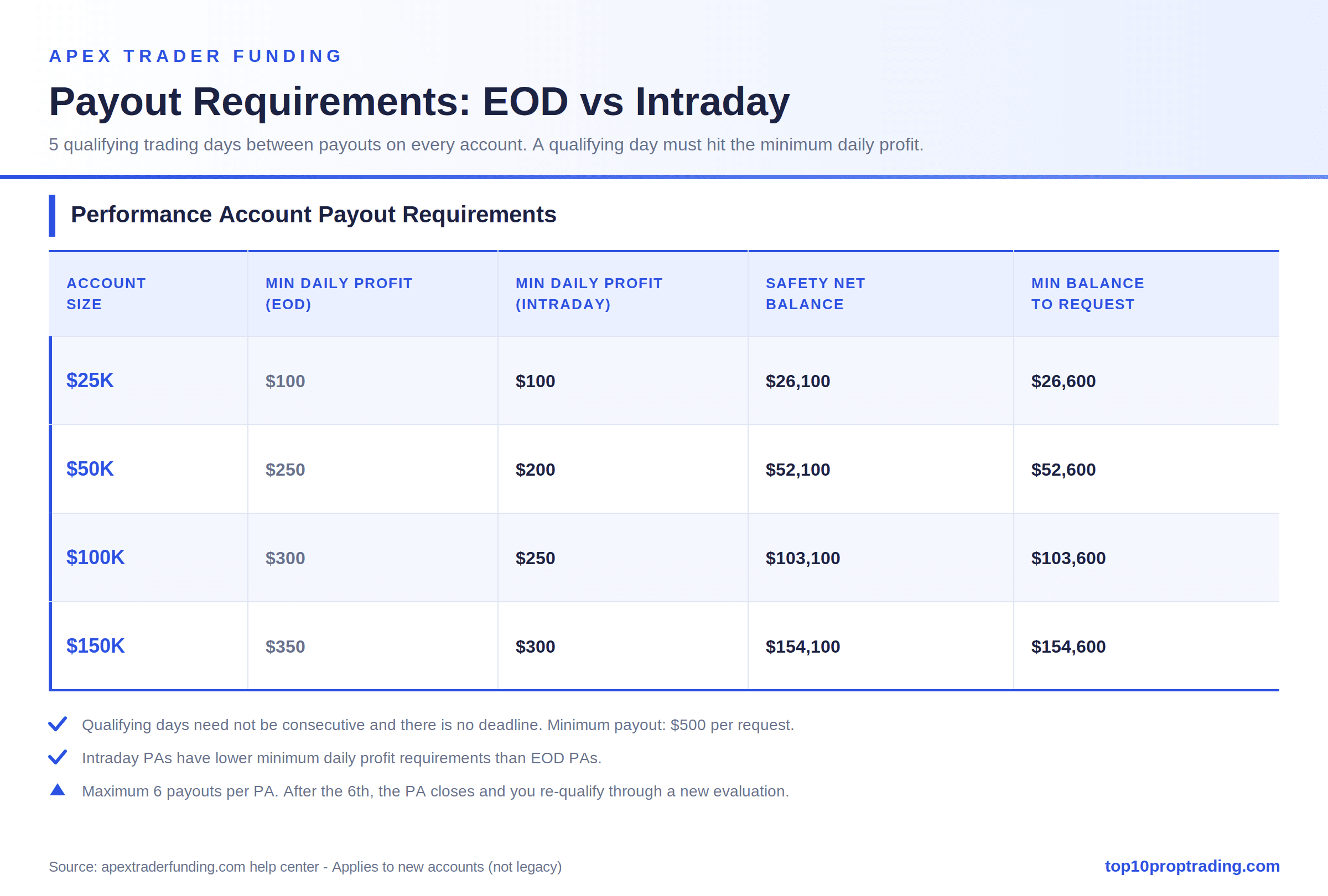
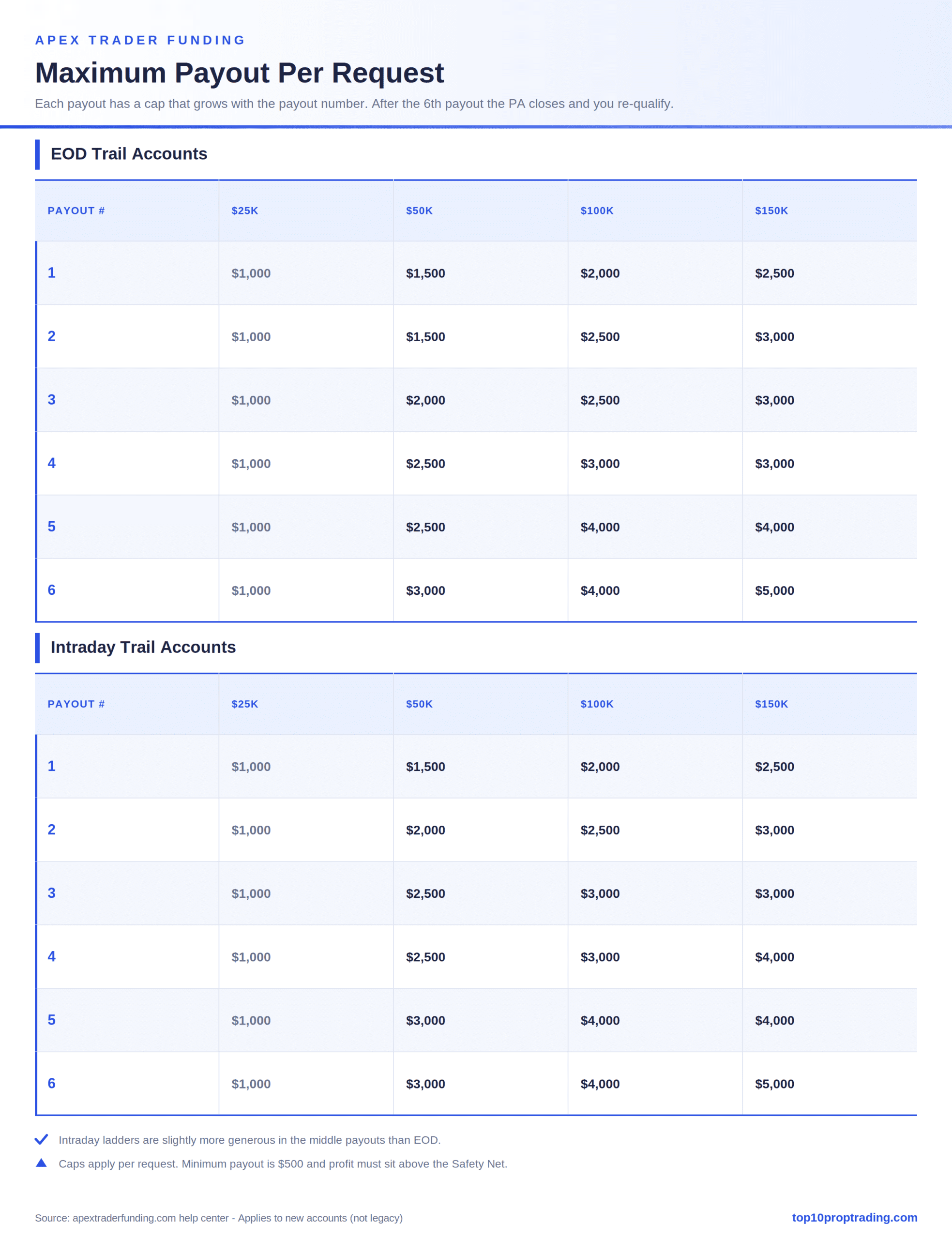
A detail almost nobody mentions: Intraday PAs have lower minimum daily profit requirements than EOD PAs ($200 vs $250 on a 50K, for example), and their payout ladders are slightly more generous in the middle payouts. Apex gives a little back for taking the tougher drawdown model.
How it works:
- 5 qualifying trading days between payouts (down from 8–10 under legacy). A qualifying day must hit the minimum daily profit for your size. Days don’t need to be consecutive, and there is no deadline. Hit five qualifying days in one week and you can be paid that same week.
- 50% consistency rule: no single profitable day may account for 50% or more of total profit since your last approved payout. (Far looser than the old 30% rule.) If you are over, the account stays active; keep trading until you are under.
- Safety Net = your drawdown limit + $100, maintained for the life of the PA. Only profit above it can be withdrawn.
- Minimum payout: $500 per request.
- Maximum 6 payouts per PA. Each payout has a cap that grows with the payout number. After the 6th payout, the PA closes and you qualify for a new one through another evaluation. This is the trade-off for the 100% split and no-denial policy: each PA has a defined payout lifecycle.
The Path Beyond PA: Apex Live
New in 3.0: traders who show strong risk management and long-term consistency in their PA may receive an invite to the Apex Live program, moving from simulated to live markets.
The Multi Account Math (Copy Traders)
Apex’s biggest structural edge remains the 20-account cap with copier support, and five-pack pricing makes stacking accounts cheaper than ever. The cheapest path to a funded account at every size is the No Activation Fee Intraday five-pack; the safest budget play if you expect to fail some evals is the Standard five-pack, since failed evals never trigger an activation fee.
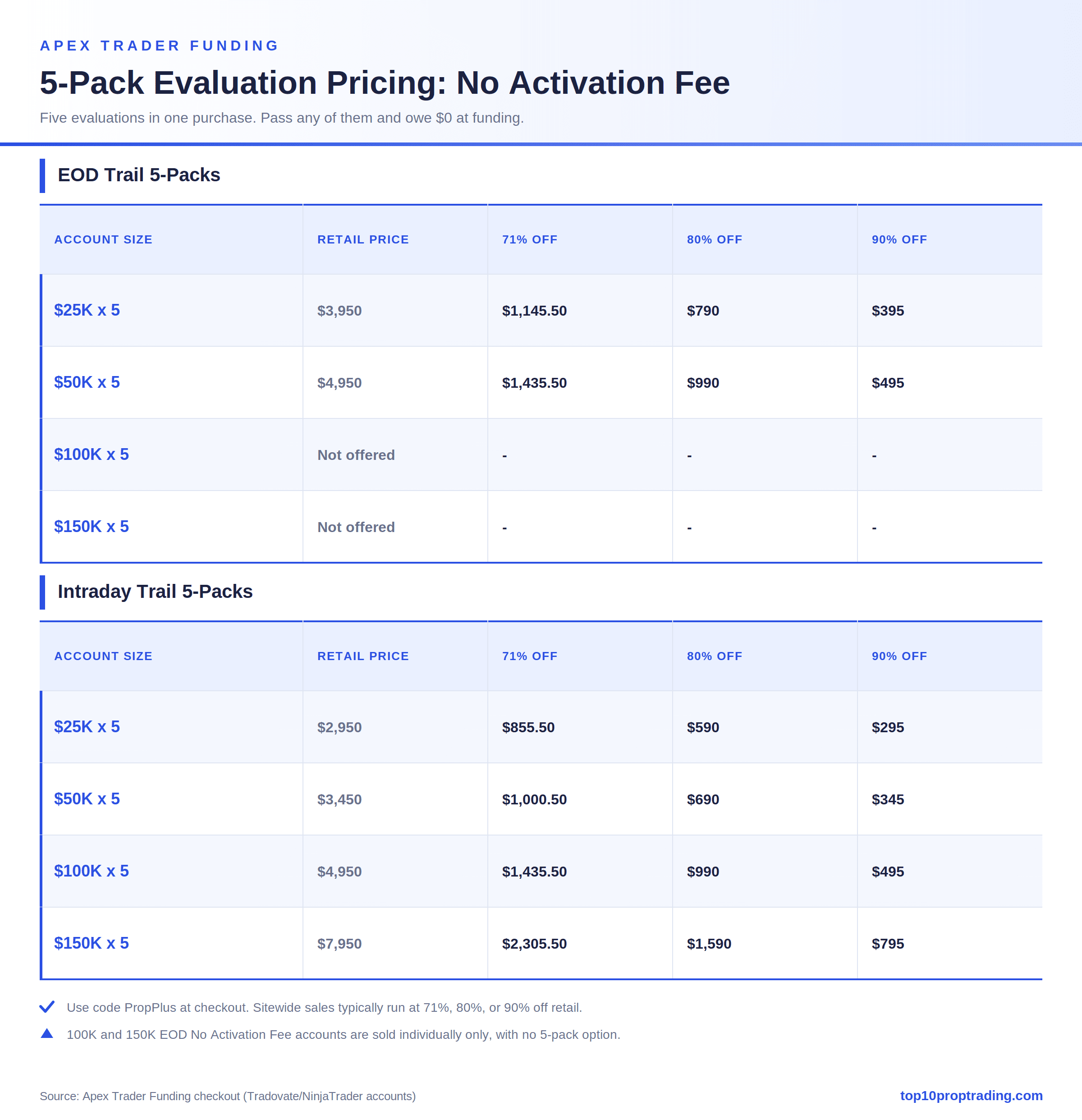
One catch for EOD copy traders: the $100K and $150K No Activation Fee EOD accounts have no 5-pack option, so stacking large EOD accounts with $0 due at funding means buying them one at a time.
Rules Apex Removed (and what they meant)
Searching for what these terms mean? Here is the plain-English version of what is gone:
MAE (Maximum Adverse Excursion): how far a trade went against you while open, even if it closed green. Legacy Apex flagged excessive MAE as poor risk management during payout reviews; traders who held losers deep underwater could have payouts denied even without breaking a hard rule. Gone: nobody reviews your MAE anymore.
5:1 Risk/Reward Rule: legacy Apex barred risking more than 5x your reward (no $800 stops chasing $100 wins). Like MAE, it was enforced retroactively at payout review. Gone: Apex no longer dictates your risk-to-reward ratio at all.
30% Rules: no single day could exceed 30% of total profit, and open profit could not exceed 30% of max account size. Replaced by the single 50% consistency rule, checked only at payout time.
The common thread: every removed rule was one that got judged by a human after the fact. The new guardrails (drawdown, DLL, 50% consistency) are all mechanical and visible in real time.
Apex Trader Funding Platforms and Instruments
Trading Platforms: Rithmic RTrader Pro, Tradovate, NinjaTrader (free license), TradingView, WealthCharts
Tradable Instruments: Equity index futures (ES, NQ, YM, RTY, and others), currency futures, agricultural futures, energy futures (CL, NG), metals (GC, SI), micro futures, and micro crypto futures (Micro Bitcoin, Micro Ethereum).
New: EUREX products — DAX, Mini-DAX, Micro DAX, Euro Stoxx 50, Euro-Bund, and other European futures (some exchanges only on Tradovate).
Apex Trader Funding Trustpilot Reviews And Statistics
Apex Trader Funding Trustpilot Review Analysis
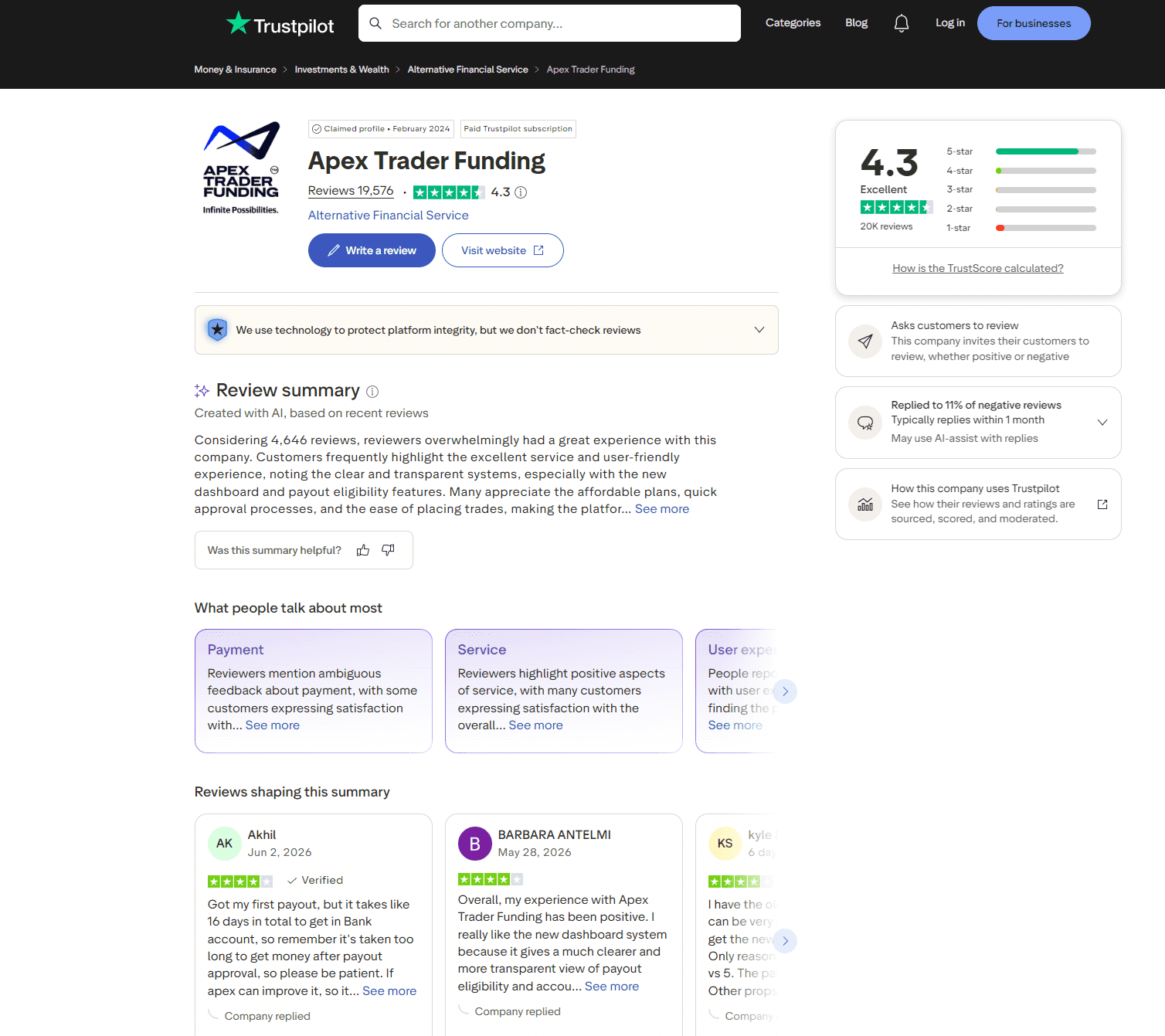
Apex holds a 4.3 “Excellent” TrustScore on Trustpilot from 19,500+ reviews, one of the largest review samples of any futures prop firm, which makes the data far more meaningful than the few-hundred-review profiles common in this industry. The profile has been claimed since February 2024 and Apex invites all customers to review, positive or negative.
To go deeper than the headline number, we analyzed 2,000 recent reviews, of which 1,858 were posted after March 1, 2026, meaning nearly the entire sample reflects the current Apex 3.0 program, not the legacy rules.
Roughly 75% of post-3.0 reviews are 4 or 5 stars (66% are five-star), while about 20% are 1 or 2 stars. The post-3.0 average sits at 4.05, slightly below the 4.3 lifetime score. Monthly 1-star rates have held fairly steady between 14% and 18% since launch, meaning the negative sentiment isn’t growing but also isn’t resolving.
Nearly half of all post-3.0 reviews mention payouts (910 of 1,858), far more than any other topic. Payouts drive both the praise and the complaints, making payout experience the single most important factor in whether a trader rates Apex positively or negatively.
What Reviewers Praise
Payouts arrive and the rules work as advertised. Of 910 payout mentions, 609 appear in 4–5 star reviews. The dominant positive pattern is simple: traders requested a payout, met the requirements, and got paid. Many describe the process as smooth and appreciate the clarity of the new rules compared to the old program.
Fast when it works. 439 reviews use words like “fast,” “quick,” or “smooth” and 389 of those are in 4–5 star reviews. When the payout pipeline operates normally, traders praise the speed.
The 3.0 rule simplification is appreciated. 81 reviews specifically reference the new program, and 60 of them are positive. Traders who experienced both legacy and 3.0 often compare favorably, citing the removal of the old 30% rules, MAE, and 5:1 restrictions. The Daily Loss Limit gets specific praise for saving accounts from blowups.
Transparent and clear. The rules, the evaluation process, and the account structure are consistently praised for being straightforward and easy to understand, especially for newer traders entering the prop space.
What Reviewers Complain About
Payout processing delays remain the #1 complaint, and they’re significant. 230 of 910 payout-related reviews are 1–2 stars. The pattern: payouts get approved but then take one to four weeks to actually arrive in the trader’s account. Multiple reviewers report waiting 9+ business days after approval, and some describe month-long waits. This is a processing/operations issue, not a rules issue, the approval happens, the money just moves slowly.
Account closures and compliance blocks are a real and recurring theme. This is the finding that the larger dataset reveals most clearly: 103 reviews mention “denied,” “scam,” or “fraud,” with 67 of those in 1–2 star reviews. The pattern is specific: traders pass evaluations, trade funded accounts profitably, request payouts, and then have accounts flagged, put “under review,” or closed — often citing identity verification failures, “copy trading” accusations, or compliance violations the trader disputes. While Apex’s marketing says “no payout denials,” the review data shows payouts being blocked through compliance mechanisms rather than traditional rule-based denials. Some of these may be legitimate enforcement; the volume and consistency of the complaints suggest it’s also a friction point for traders acting in good faith.
Support is genuinely mixed. 388 reviews mention support — 236 positive, 136 negative. Positive reviews praise responsive, knowledgeable staff. Negative reviews describe unresponsive ticketing systems, auto-closed tickets, and days-long waits for resolution on time-sensitive account issues. The new helpdesk system gets specific criticism.
The monthly trend is worth watching. March (launch month) averaged 4.23, but subsequent months have trended lower: April 4.09, May 3.89, June 3.95. The 1-star rate has edged up from 14% in March to 17–18% in May/June. This isn’t a collapse, but it’s a slow drift in the wrong direction that tracks with the payout delay and compliance complaint patterns intensifying after the initial launch honeymoon.
Bottom Line on Reviews
The 2,000-review picture is more nuanced than the headline 4.3 TrustScore suggests. Three out of four post-3.0 traders rate Apex positively, the rule simplification is genuinely appreciated, and when the system works as intended, payouts are smooth and fast. But the data also shows a persistent minority (roughly 1 in 5) with serious complaints centered on two issues: payout processing delays that stretch into weeks, and account closures or compliance holds that block payouts through mechanisms traders find opaque. The “no payout denials” marketing is technically accurate in a narrow sense, payouts aren’t denied by rule-review, but the practical experience described in negative reviews is that payouts can still be blocked.
If Apex accelerates its processing pipeline and adds transparency to its compliance review process, the trajectory could recover. If neither changes, the slow monthly drift will eventually pull the lifetime score down.
Review analysis based on 2,000 reviews (1,858 post-Apex 3.0), collected July 2026. Lifetime TrustScore: 4.3/5 from 19,500+ reviews.
Apex Trader Funding 3.0 Key Takeaways
- 30-day time limit on evaluations (legacy had none)
- NO resets: a failed or expired eval means buying a new one
- 50% consistency rule on PA payouts
- PA contract limits are lower than evaluation limits
- EOD drawdown option, open profit no longer trails against you intraday
- 100% payout split on all approved payouts (Sim Funded)
- NO payout denials, reviews, or video/screenshot requirements
- No MAE rule, no 5:1 risk/reward rule
- One-time fees, no recurring billing
- Evals from under $20 on coupon
- Pass in as little as one day; no eval consistency rules
- Payouts possible weekly (5 qualifying days)
- Trade up to 20 accounts simultaneously; five-packs cut per-account cost ~15–20%
- Built-in tier-based scaling; oversized orders rejected without penalty
- DLL pauses you instead of failing you (EOD accounts)
- EUREX products added
- Lowest E-mini Micro Commission
Conclusion on Apex Trader Funding
Apex Trader Funding has responded directly to its biggest historical criticisms. The old Apex was famous for cheap evaluations but infamous for a dense, frequently changing PA rulebook and payout denials. The new program strips that back to a handful of clear, mechanically enforced rules: respect the drawdown, respect the daily loss limit, hit 50% consistency, and get paid, with a 100% split and no payout reviews.
The trade-offs are real. Evaluations now run on a 30-day clock with no resets, payouts are capped per request, and each PA has a 6-payout lifecycle before you must re-qualify. Traders who used to grind a single PA indefinitely will need to adjust to the cycle. But the economics still favor the trader: a coupon-priced eval costs less than a legacy reset did, and the all-in cost to a funded account starts under $70 during a 90% sale (a $25K No Activation Fee Intraday at 90% off is $69, with nothing owed at funding).
For traders who value transparency and payout certainty, and especially for those running multiple accounts with a copier, this is arguably the most trader-friendly structure Apex has ever offered. Combined with industry-leading pricing, frequent deep-discount sales, and the End of Day drawdown option, Apex has earned the #2 spot on our list of Top Prop Trading Firms.









Apex Trader Funding Current Discounts/Coupon Codes
| Coupon | Product(s) | Discount |
|---|---|---|
| PropPlus | All evaluation accounts | 90% |

Restricted Countries
Afghanistan, Côte d’Ivoire, Laos, Slovenia, Albania, Crimea, Lebanon, Somalia, Algeria, Croatia, Liberia, South Sudan, Angola, Cuba, Libya, Sri Lanka, Bahamas, Democratic Republic of Congo, Mauritius, Sudan, Barbados, Ecuador, Mongolia, Syria, Belarus, Ethiopia, Montenegro, Trinidad and Tobago, Bosnia and Herzegovina, Ghana, Nicaragua, Tunisia, Botswana, Iceland, North Korea, Turkey, Bulgaria, Indonesia, Pakistan, Uganda, Burma (Myanmar), Iran, Panama, Ukraine, Burundi, Iraq, Papua New Guinea, Vietnam, Cambodia, Jamaica, Russia, Venezuela, Central African Republic, Kosovo, Serbia, Yemen, Zimbabwe, Burkina Faso, Kenya, Philippines, Cameroon, Macedonia, Qatar, China, Mali, Romania, Gibraltar, Mozambique, Senegal, Haiti, South Africa, Hong Kong, Namibia, Tanzania, Jordan, Nigeria, and United Arab Emirates.
Apex Trader Funding Commission Comparison
| ROUND TRIP | E-mini Micros Equities | E-mini Equities | Currency Futures | Ag Futures | Energy Futures | Metals Futures | Crypto Futures |
|---|---|---|---|---|---|---|---|
| Top One Futures | 1.9 | 5.76 | 6.20 | 7.20 | 6.00 | 6.20 | 3.20 MBT |
| BluSky Trading | 1 | 4 | 4 | 4 | 4 | 4 | N/A |
| Apex Trader Funding | 1.02 | 3.98 | 4.72 | 5.58 | 3.96 | 4.62 | 5.52 MBT / 0.92 MET |
| Purdia Capital | 1.74 | 5.68 | Varies | 7.12 | Varies | 6.12 | 14.92/6.04 |
| TakeProfit Trader | 0.5 | 5 | 5 | 5 | 5 | 5 | N/A |
| DayTraders | 1.02 | 3.98 | 4.72 | 5.58 | 3.96 | 4.62 | N/A |
| Bulenox | 1.22 | 4.18 | 4.72 | 5.72 | 4.52 | 4.62 | 5.52 MBT / 0.92 MET |
| Elite Trader Funding | 1.12 | 4.08 | 4.72 | 5.62 | 4.52 | 4.62 | 13.52 / 11.52 |
| TradeDay | 1.54 | 4.68 | 5.12 | 6.12 | 4.92 | 5.12 | N/A |
| Tradeify | 1.74 | 5.68 | N/A | 7.12 | 5.32 | 6.12 | N/A |

How We Determine The Best Firms

In our comprehensive reviews of proprietary trading firms, we evaluate a wide range of factors to provide traders with a complete picture. We start by examining the company’s background, including its founding, leadership, and overall reputation in the industry. We then delve into the account types and sizes offered, along with the specific evaluation processes and trading conditions.
This includes analyzing profit targets, drawdown rules, and any restrictions on trading hours or instruments. We closely examine the profit-splitting structure, payout speeds, and withdrawal policies, as well as any commissions charged. The pricing model for both evaluation and funded accounts is scrutinized, including any additional fees for data feeds or platforms. We assess the trading platforms supported, any educational resources provided, and the quality of customer support. Scaling opportunities and unique features that set each firm apart are highlighted.
We also consider the overall user experience, the company’s transparency in its rules and risk disclosures, and the firm’s reputation among traders, often referencing Trustpilot scores or other review aggregators.
Our reviews aim to give traders a thorough understanding of what each prop firm offers, enabling them to make informed decisions based on their individual trading needs and preferences.
Top Trading Tools 2026





Join our mailing list...
Be the first to receive the latest discount codes, insider deals, and special offers from the top prop trading firms—all delivered straight to your inbox. Don’t miss out on savings in the fast-paced competitive nature of these special promotions.
Join our mailing list now and stay ahead of the game!